Stages of soft tissue healing
After a connective tissue injury, whether it is a mechanical injury (including surgery) or chemical irritation, the tissue begins to react to the injury. Biological tissue is subjected to mechanical trauma in the form of tension, compression and shear. Connective, bone, muscle, and nerve tissue react differently to excessive action of internal and external forces depending on the components of each structure, the physiological state of the tissue, the size, speed, and direction of the force. Once trauma occurs, the connective tissue response and healing stages are similar, but individual differences must also be taken into account.
Healing is a continuous process that, depending on the characteristics and clinical signs, can be divided into 3 stages:
Phase I – acute stage (inflammatory reaction)
Phase II – subacute stage (regeneration, repair)
Stage III – chronic stage (maturation and remodeling of the scar)
1. Acute stage (first 48-72h)
Soft tissue injury is damage to the cells of the injured structure. The phase of tissue inflammation develops at the site of tissue damage a few hours after injury. This stage involves both cellular and humoral reactions due to the action of chemical compounds that are produced during the liquefaction of dead cells on the walls of blood vessels. During the first 48 hours after a soft tissue injury, vascular injuries are most pronounced. Immediately after the injury (the first 5 to 10 minutes), vasoconstriction occurs, followed by active vasodilation of local blood vessels and increased circulation. The permeability (permeability) of small venules increases and edema (swelling) becomes noticeable at the site of the lesion due to exudation (exudation – exit of fluid and cells from blood vessels) of cells and chemical substances. As a symptom, there is also pain that occurs for two reasons:
- Pressure of exudate on the nerves and direct mechanical stimulus due to increased pressure in the tissue
- By irritating pain receptors with chemical stimuli produced by dead cells
The most common duration is 48-72 hours, but depending on the type and nature of the injury itself, the possible duration is 3-5 days.
Physiological processes in the phase of inflammation serve not only as a protective mechanism, but also as a stimulus for the healing and repair of damaged tissue, which will follow. Most symptoms of acute traumatic inflammation decrease and disappear within the first two weeks of injury. Chronic inflammation has the effect of destruction of surrounding tissue, is resistant to physical and pharmacological treatment.
The main clinical signs of inflammation :
- Redness (rubor)
- Swelling (tumor)
- Increase in local temperature (calor)
- Bol (dolor)
- Decreased function (functio laesa)
2. Subacute stage (next 10 – 17 days)
This period occurs when the inflammation subsides, the dissolution of the coagulum and the repair of the injured area begins. A coagulum is a spicy, semi-solid mass that is formed to form capillary buds that grow towards the place where the concentration of oxygen is lowered. Already on the 3rd or 4th day after the injury, new capillary tissue called granulation tissue is visible on the superficial wounds. The activity of fibroblasts increases and they begin to deposit collagen in the matrix. Granulation tissue from the edges of the wound grows into the coagulum, filling the tissue defect caused by the injury.
Collagen fibers polymerize and immature connective tissue is formed, which is still thin and disordered. The process of organization that should follow, implies the complete replacement of dead masses with connective tissue, the end result of which is the formation of a scar. Due to inactivity, the collagen fibers are in constant contact and at the points of interception they stick together and abnormal transverse connections are formed that now do not allow elongation and restrict movement. Although newly formed tissue is very fragile and can be easily damaged if subjected to too much load, nevertheless, the appropriate growth and organized arrangement of collagen tissue can be stimulated by appropriate loading. The correct movement for a certain healing structure is a normal action of stress, because fibroblasts thus acquire orientation in terms of the direction in which they should form and dispose of collagen fibers. At the same time, adhesions (adhesions) to surrounding tissues can be reduced.
The tissue begins to shrink more severely after 3 weeks of injury. For this reason, specific stretching of the injured tissue is necessary. Collagen metabolism is characterized by continuous synthesis and degradation, so if the synthesis exceeds the degradation, fibrosis will occur. Fibrosis is an increased accumulation of connective tissue and therefore increased resistance within the soft tissues. This occurs not only during the inflammatory process, but also at rest, immobilization, and inactivity.
3 . Chronic stage
In the final stage of soft tissue healing, the firmness of the glued edges of the tissue defect is achieved. Granulation tissue is transformed into well-circulated connective tissue, i.e. An immature scar. With the procedure of remodeling and directing collagen threads in the direction of the load forces, the so-called mature scar is formed, which most often does not achieve its firmness that it had before the injury. The maturation phase (maturation of the scar) lasts up to 2 years. Remodeling takes place all the time as the collagen fibers become thicker and change their arrangement to the action of the load, reorient themselves, i.e. They’re reorganizing. The higher the density of connective tissue, the longer the time period of remodeling lasts. During this phase, it is also very important that the tissues are exposed to a properly directed load, otherwise they will tend to stick to the surrounding tissue and form a scar of reduced elasticity.
As the structure of collagen changes and becomes thicker, it also becomes stronger and more resistant to remodeling. Tissue healing is impaired if inflammation, hematoma or sutures are constantly present in the area of injury, so these negative effects interfere with tissue repair.
Application of stretching
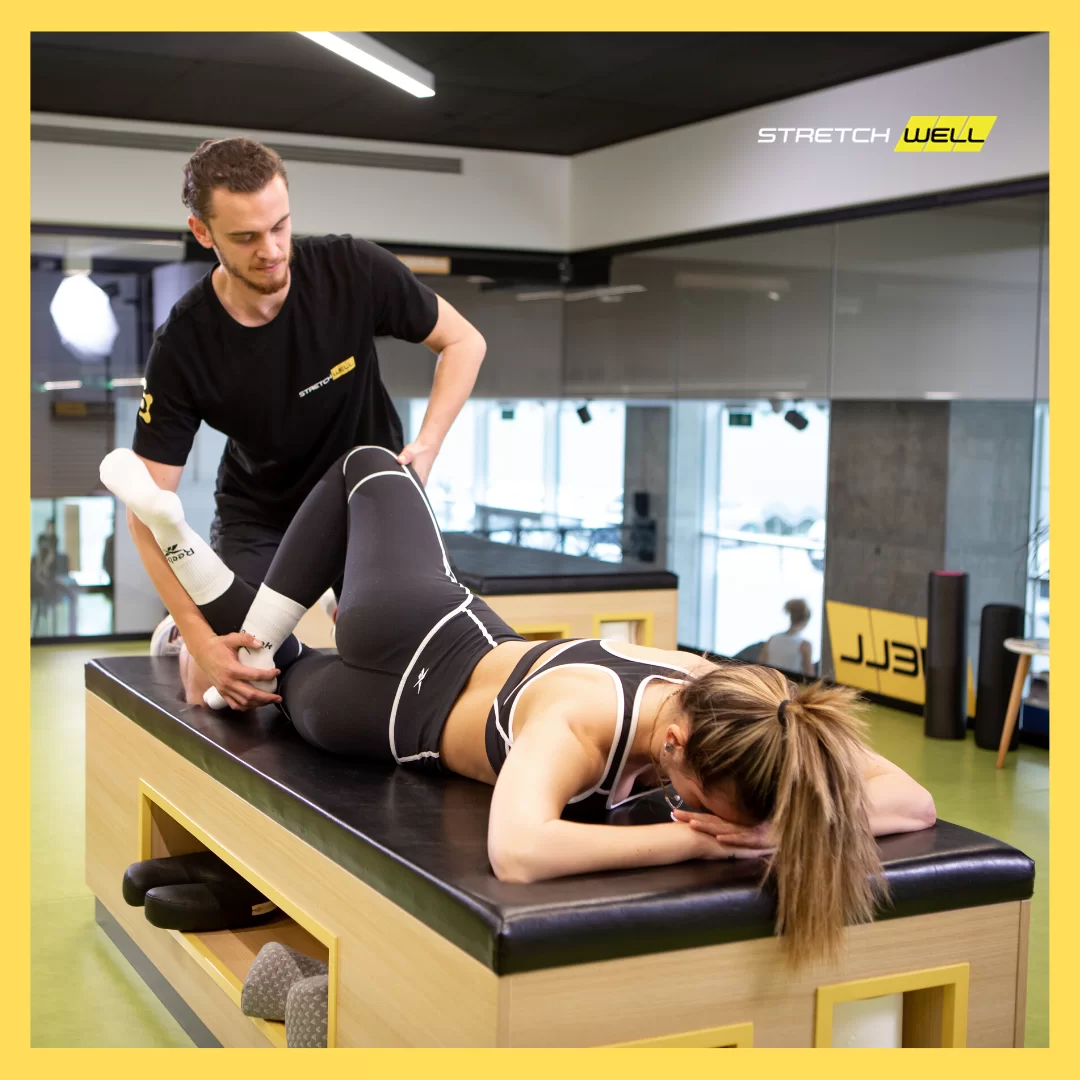
One of the most important goals of post-injury rehabilitation is to restore movement to the injured part of the body by working on coordination, strength, and flexibility. Muscles can become tense and inflexible when not in use, so stretching is used as one method to restore normal function after an injury. Stretching during recovery should be slow, dosed and careful and aims to elongate muscle tissue and build strength and coordination gradually over time. Usually, stretching is not recommended in the first week after an injury because the body is trying to regenerate and, depending on the type of injury, can even cause more damage.
A typical recovery regimen for relatively minor injuries may begin as early as a week after the injury. This early stage may involve slow, static stretching that aims to increase blood flow to the affected area. After about two weeks, stretching may be more frequent and intense, focusing on regaining flexibility, coordination, and balance. After about five weeks, static and dynamic stretches can be used to increase the strength of the neglected muscles. Another benefit of stretching for recovery is that it can alert you to any problems related to movement. Since it is a way of slowly moving again in the range of motion, it can sometimes be important to warn of the difficulty of healing.
It is very important to choose the right type of stretching during a certain phase of recovery. In the first, acute phase, only the R.I.C.E. regime should be applied. It includes rest, the use of cryotherapy, i.e. the application of ice (“ice”), compression of the injured area (“compression”) and elevation (“elevation”). At this stage, stretching should be avoided because the tissue is still very sensitive and the use of stretching can worsen the clinical picture and prolong the duration of the inflammation phase itself.
After 2-3 days, most of the swelling recedes, as well as other symptoms of inflammation, which gives us the opportunity to apply gentle techniques of active rehabilitation. The most effective treatment at this stage is the use of heat and massage, but also the inclusion of light, gentle static and passive stretching exercises after heat treatments. These techniques will significantly speed up the entire recovery process. The most important thing in the application of passive and static stretching is to perform a light, gentle stretch. Do not engage in any activity that causes pain in the injured area. A lot of caution is required during any activity that is carried out. Pain is a warning sign and should not be ignored.
The further course of rehabilitation is aimed at restoring all the components that were lost as a result of the injury. For the next 2-5 weeks after the injury, improving flexibility, strength, muscular endurance, balance, and coordination form the main focus. It is recommended to use the described static and passive stretching exercises, but PNF stretching techniques are also included. They are a bit more intense for the muscle because they involve the contraction of the muscles before the stretching itself to a new range of motion.
After restoring all components, it is necessary to focus on making the injured part stronger and more flexible and in order to prevent re-injury. It is known that an area that has been exposed to some kind of injury or stress is more susceptible to re-injury, so this long-term phase has an emphasis on further strengthening and improving mobility. Dynamic and active stretching can be used here. Dynamic stretching is used in a controlled manner using soft motion, bounce, or swinging to move a particular part of the body to the limit of its range of motion. The force of the bounce or swing gradually increases, but it should never become uncontrollable. Active stretching is performed without any help or assistance from an external force. This form of stretching involves only the strength of the opposing muscles, i.e. antagonist muscles, to create stretching within the target muscle group. The contraction of the opposing muscles also helps to relax the muscles that we stretch.